Sunshine Clothings
Customized Sales Customer Relationship Management Tracking Locally Deployed Software Based on AI CRM Solution
Customized Sales Customer Relationship Management Tracking Locally Deployed Software Based on AI CRM Solution
Regular price
$2,100.00
Regular price
$3,500.00
Sale price
$2,100.00
Shipping calculated at checkout.
Quantity
Couldn't load pickup availability
SPECIFICATIONS
Accuracy: Development mode
Function customization: support
Presentation format: APP,PC
Product name: Customer Relationship Management CRM System
brand name: Glit
model number: CRM
operating systems supported: Linux,MAC,Windows
place of origin: Hebei, China
products status: Stock
type: CRM Customer Management System Software
version type: Internet

AI function: (customizable)
To do:
1. Intelligent to-do list sorting: AI automatically sorts "who should be contacted first today" based on customer value, urgency of follow-up, and probability of winning orders. Sales know priority at a glance
2. Predictive reminder: AI predicts that "A customer has not followed up for 3 days, and if not contacted again, it may cool down", actively pushing it to the top of the to-do list to avoid missing important customers
3. Best contact time: Analyze the customer's history of answering phone calls/messages, recommend "contact at 10:30" to improve the connection rate
Clue management:
1. Similar transactional customers (recommend "the most similar transactional customer to this lead" as a sales reference language to shorten the ice breaking time)
2. Clue rating: AI automatically scores each clue (0-100 points), telling sales whether it is worth spending time on. [Focus on high-value clues to improve conversion]
Customer management:
1. Customer Health Rating: Recent follow-up time, follow-up content, contract performance and other information, displaying health score
2. Customer churn warning: AI monitoring follow-up frequency decreases, contracts are about to expire but not renewed, marked as "high churn risk", pushed to the pending list
3. AI scores each customer in the high seas and marks them as "high-value to pick up" [Sales quickly locks in high-quality customers]
Collection management:
Payment overdue prediction: Predict which payment plans may be overdue and provide early warning
Collection advice: Recommended collection techniques, best contact time, recommended contact person
Dialogue assistant: check data, clues, customers, contracts, and payment receipts; Analyze, follow up, and predict transactions; Get advice


System Introduction
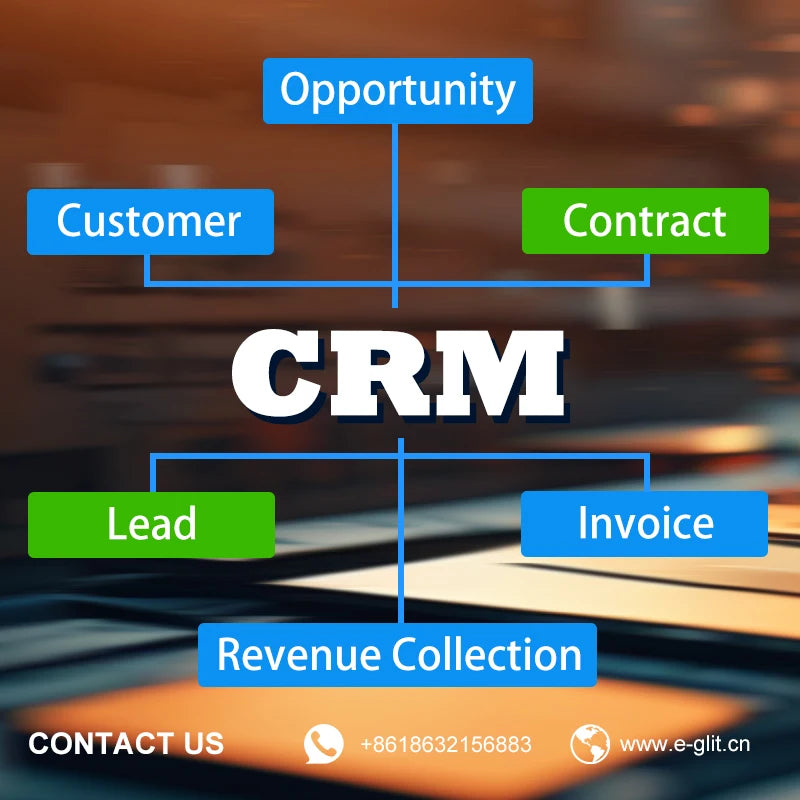
Customer Relationship Management (CRM) systems are designed for small and medium-sized enterprises as well as growth oriented businesses, particularly suitable for sales driven industries; It is a customer-centric full process digital management platform. The system starts from obtaining leads and uses automated rules to incubate and convert valid leads into formal customers. Subsequently, contact person maintenance, business opportunity tracking, contract signing, and payment management were carried out around the customer to form a complete business closed loop. The system supports customers' open sea recycling, flexible adjustment of related relationships, contract review to ensure compliance, and is supplemented by product libraries, data statistics, and visual reports to achieve systematic management of customer resources and standardized sales processes, comprehensively improving customer lifecycle value and sales operation efficiency.
Support and Empowerment System
Product management: Maintain enterprise product/service information for quick reference of contracts and business opportunities.
Data statistics: comprehensively summarize and analyze customer, business opportunities, contracts, payments, and other data, generate visual reports, and provide strong support for management decisions.
System configuration: Flexibly configure high seas rules, approval processes, basic data, etc., to perfectly match system rules with enterprise systems.
Value Summary
This system helps enterprises achieve the following by integrating "unified customer information, standardized sales processes,
automated business rules, and visualized data analysis":
automated business rules, and visualized data analysis":
Improve sales efficiency: automate processes to reduce manual operations and focus on core follow-up.
Preventing customer churn: The high seas mechanism and full process tracking ensure that customer resources are fully utilized.
Ensuring financial health: Contract payment plan payment closed-loop management to accelerate capital flow back.
Drive scientific decision-making: Based on full process data, gain insights into sales performance and customer trends.

Application Scenarios
This system is particularly suitable for growth oriented enterprises with high customer value, long sales cycles, multiple team collaborations, and a focus on process management and data analysis, helping them achieve the transformation and upgrading from extensive growth to refined operations.
Scenario 1: Long and complex customer journey in sales management
Typical pain points: Long customer decision-making chain, involving multi role communication, difficult to track sales process, and easy omission of key nodes.
System value: Through the standardized process of "leads → customers → business opportunities → contracts → payments", the long-term sales process is decomposed into visualized stages. Record key activities and decision points at each stage to ensure standardized sales actions, transparent processes, and improve the success rate and predictability of complex sales.
Scenario 2: Customer Resource Collaboration and Efficient Circulation
Typical pain points: Customer resources are scattered in the hands of individual salespeople, new employees lack guidance, and resignations lead to customer loss; Idle customer resources have not been effectively activated.
System value: Through the "customer open sea" mechanism and complete customer files, achieve the corporate sedimentation and fair redistribution of customer resources. After sales turnover or customer follow-up exceeds the time limit, customers will automatically or manually return to the open sea and be reassigned by managers to maximize the utilization of each customer resource.
Scenario 3: Integration of Business and Finance and Risk Management
Typical pain points: disconnect between sales and financial data, unplanned collection after contract signing, extensive accounts receivable management, and high risk of bad debts.
System value: Establish a strong correlation chain from "contract → payment plan → actual payment". After the contract review is approved, a payment plan can be created, and the system automatically tracks the due status of each accounts receivable and provides overdue warnings. Realize closed-loop management from signing to fund withdrawal, accelerate cash flow turnover, and control financial risks.

Applicable Enterprises
Divided by business model:
B2B service/solution providers: such as SaaS enterprises, software developers, management consulting firms, marketing service agencies, etc. Its business relies on deep customer relationships and long-term value delivery, and urgently needs systematic management of the long sales and service cycle.
Project based and complex product sales companies, such as industrial equipment manufacturers, commodity traders, system integrators, etc. The sales process involves technical solutions, multiple quotations, contract approval, and installment payments, requiring precise tracking of each step.
Distribution channel and partner management: Brand owners need to manage the customer coverage, business opportunity reporting, and performance attribution of distributors and agents within the system to avoid channel conflicts and achieve collaborative sales.
Divided by enterprise size and development stage:
Small and medium-sized enterprises in the rapid growth stage: The number of customers and team size are rapidly expanding, and there is an urgent need to replace decentralized management methods such as Excel and personal WeChat. Through the system, customer resource integration and sales process standardization can be achieved to support large-scale growth.
Enterprises with a sales team of at least 5 people need to standardize sales actions through a system, strengthen process coaching and collaboration, effectively manage sales funnels, and achieve overall team efficiency improvement.
Multi branch offices or remote teams: A unified customer information platform is needed to ensure synchronization of information across regions and teams, eliminate internal conflicts, and achieve optimal resource allocation and standardized service delivery.
Divided by core management requirements:
Pursuing controllable and replicable sales process: not only focusing on sales results, but also committed to consolidating best practices into standardized processes, achieving rapid replication of sales capabilities and team development.
Highly value customer asset security: regard customer data as a core asset, establish security mechanisms to prevent customer resources from being lost due to personnel turnover, and ensure the preservation of enterprise assets.
Relying on data-driven business decisions: Management requires real-time and accurate sales funnel analysis, performance forecasting, customer analysis, and other data reports to make scientific strategic and resource allocation decisions.

Functional Description (Partial Features)
To-do
Contact customers today: Remind customers who need to be followed up on that day to avoid missing important communication.
Assign leads/customers: Display potential leads and customer resources that are exclusively assigned.
Customers waiting to enter the open sea: Alert customers who are about to enter the open sea for timely follow-up.
Pending Contract/Payment Collection: Centralized display of contracts and payment requests that require approval to ensure compliance.
Pending payment reminder: Automatically push pending payment contract information to assist in fund recovery management.
Expiring contract: Remind of contracts that are about to expire, making it easier to follow up on renewal in advance.
System Homepage
The centralized display entrance for all business data in the system aggregates real-time data statistics of today's pending customers, business opportunities, leads, as well as core business modules such as expiring customers, pending payment contracts, invoices, etc. At the same time, it presents reminders of contract approval and collection approval waiting processes, and also displays a list of key information for created contracts. Its significance is to help users quickly grasp the current business progress, to-do items, and core data, and to overview the global business status without switching modules, improving the efficiency and timeliness of business management.
Data Statistics
The data statistics module provides decision support for the system, integrating multi-dimensional data such as customer analysis, rankings, and employee performance. Through indicators such as total customer volume, conversion rate, and transaction cycle, combined with dimensions such as employee performance rankings and sales funnel, it visualizes business operations and assists enterprises in making accurate decisions.

Customer Management
The core module of the system, which centrally manages the full amount of customer information, can directly create business information such as contacts, business opportunities, contracts, and payments in the customer detail page, and integrate multi-dimensional content such as follow-up records and basic information to achieve business linkage and information traceability throughout the customer's entire lifecycle.


Contact Management
Used to maintain contact information bound to customers, supporting the association of corresponding customers with contacts. At the same time, business opportunities can be directly created or associated on the contact details page, achieving business linkage between contacts, customers, and business opportunities, and assisting in the deep follow-up and conversion of customer resources.

High Seas Customers
The resource pool that operates based on system configuration rules will automatically enter the "public sea" when the customer fails to be followed up or does not make a transaction within the set number of days. Members of the public sea customer support team can claim these resources independently, or they can be distributed to other team members. This helps to utilize idle customer resources and improve the efficiency of customer conversion.
Follow-up Record
Track the customer follow-up process; Centralize the retention of customer follow-up content, methods, and next contact time information, and restore the follow-up process through recording and precipitation, facilitating the connection of follow-up and the review of business processes.
Customer Duplicate Check
To address the issue of duplicate customer information, unified management can be implemented for suspected duplicate customer information; Its significance lies in identifying and collecting duplicate customer data, which can add supplementary information related to plagiarism checking, help avoid customer information redundancy, ensure the uniqueness and accuracy of customer data, and improve the efficiency and quality of customer management.
Opportunity Management
Used to track potential transaction opportunities, it is necessary to bind corresponding customers, record associated product information on the opportunity details page, and support direct contract creation to achieve business flow from opportunity to contract. At the same time, follow-up records should be retained to ensure traceability of opportunity promotion.


Follow-up Record
Settling the process of following up on business opportunities; Its significance lies in retaining information such as follow-up content, methods, and next contact time corresponding to business opportunities, and restoring the trajectory of business opportunities through recording, which facilitates the connection of follow-up and business review.
Clue Management
Unify the management of potential customer lead resources, support precise screening based on lead status and information characteristics, and achieve orderly management of lead resources; At the same time, the clue details fully present the core information of a single clue, integrating multi-dimensional content such as follow-up records and basic information, and comprehensively displaying the full cycle interaction trajectory of the clue.


Contract Management
Used to manage contract information corresponding to customers and business opportunities, the associated product content can be displayed on the contract details page, supporting the creation of payment plans and actual payment records. At the same time, there is a built-in review process, and contracts need to be approved before proceeding with payment and other subsequent operations, achieving full lifecycle control and business linkage of contracts.

Payment Plan and Records
Used to develop phased payment arrangements for contracts, specifying the amount, date, and method of payment for each period; The payment record module tracks the actual payment status of the contract, associates the payment plan with the contract information. This module follows the rule that the contract must be approved before payment can be initiated, and the payment process also supports setting up an audit process to ensure the compliance of payment operations and the rigor of fund control.

My Invoice
Manage contract invoice information, enter invoice details, select associated contracts, fill in invoicing subject, header, amount and other information to complete registration; Centralize the management of invoice issuance information, types, and other data, standardize the invoice issuance and recording process, assist enterprises in achieving compliance management of financial invoices, and connect contract and financial links to enhance the synergy between business and finance.
Approval Management
Configure business approval rules, create approval processes, fill in names and types, add approval steps for specified users/departments, and enable them; Set compliant approval rules for business processes such as contracts, invoices, and payments. Only by completing process configuration can corresponding business steps be used correctly, thereby standardizing the authority and process of business flow, ensuring the compliance and risk controllability of enterprise business operations.
Product Management
The basic support module of the system is used to maintain comprehensive product information, covering core fields such as product name, type, code, unit price, unit, and listing status. It supports the addition, editing, deletion, and status control of products, providing standardized product data support for business modules such as business opportunities and contracts, ensuring consistency and accuracy of product information in business processes.

System Configuration
Used to define the core business rules of the system, it can uniformly configure customer high seas circulation rules, contract reminder rules, product classification standards, etc., and ensure the standardization and automation of business processes through standardized settings.

Function list (customizable) and delivery content
To-do
clue management
Customer Management
Contact Management
Customer Open Sea
Opportunity Management
Contract Management
Payment Collection Management
Payment Plan
Product Management
data statistics
System Configuration
In addition to the existing standardized functions and delivery content, this system supports in-depth customization development, allowing for tailored adjustments to functional logic based on the unique business characteristics of enterprises, such as special processes and industry-specific modules. At the same time, it provides localization adaptation services, including adapting to the existing IT environment, compliance requirements, and business terminology of enterprises. Currently, whether it is a localized deployment or a SaaS solution, customization needs can enjoy exclusive price discounts, helping enterprises to implement a management system that adapts to their own scenarios at a low cost.
Deliverables
Localized deployment:
1. Permanent system usage license certificate
2. Operation manuals for various roles in the system
3. Training videos and operation guides
4. System deployment environment documentation
5. Deployment, installation, and debugging services
6. Design of historical data migration scheme
7. Source code/executable package (optional)
SaaS cloud deployment:
1. Customer-specific data isolation certificate
2. Dedicated customer instance deployment and configuration
3. System login account and permission allocation
4. Online data import and verification
5. Online system operation training courses
6. Real-time remote guidance service
7. System automatic update and maintenance
8. Daily data backup and security monitoring
9. Customer service support and problem response
1. Permanent system usage license certificate
2. Operation manuals for various roles in the system
3. Training videos and operation guides
4. System deployment environment documentation
5. Deployment, installation, and debugging services
6. Design of historical data migration scheme
7. Source code/executable package (optional)
SaaS cloud deployment:
1. Customer-specific data isolation certificate
2. Dedicated customer instance deployment and configuration
3. System login account and permission allocation
4. Online data import and verification
5. Online system operation training courses
6. Real-time remote guidance service
7. System automatic update and maintenance
8. Daily data backup and security monitoring
9. Customer service support and problem response


FAQ
1.How much does a software cost?
The price of software depends on multiple factors. Our basic version will provide core features. If you need customized development or add specific modules, the price will be adjusted according to the difficulty of the features and specific needs. After understanding your detailed requirements, we will provide you with a competitive discounted quotation.
2. Is it possible to customize software
We support customized software. After understanding your requirements and desired features, we will provide you with a basic solution and discuss specific functional content based on the basic solution.
How long does it take to develop a software?
Usually, when we are asked this question, unfortunately, the answer is: it's all different. The development time of software depends on multiple factors such as whether it is customized, the difficulty of customizing features, and the size of the software project.
3. What can you purchase from us?
Software development, mobile application development, software customization development, website design, IoT platform development, artificial intelligence integration services, GIS 3D visualization application development
4.Why do you want to purchase from us instead of other suppliers?
We are a software development company with over ten years of experience, accumulating mature experience and a stable and reliable technical team in the industry. We hold ISO software development and sales system certification, and have multiple software copyright certificates. We will also help you meet your software requirements at the lowest price.
5. Software delivery method/delivery content
Localized deployment: source code/executable package (optional), SaaS cloud deployment with two options
Looking forward to working with you!